Skip to content

Cart

Your cart is empty

Jianping Chen 陳建平

Champion of Fujian Black Tea Competition 2023
A person wearing glasses and a maroon jacket processes tea leaves by hand on a large bamboo tray in a wooden room.

My Path Back to the Leaf

I was born into tea. My family in Fu’an had made Tan Yang Gong Fu black tea for generations. From a young age, I saw both the beauty of our craft and the challenges within it. Some traditional methods limited quality, and many families like mine depended on this tea for their livelihood. I wanted to change that. This was why I made it to university to study tea science. I hoped modern knowledge could help our traditional tea grow stronger. University gave me theory, but after graduating, I realized books can only take you so far. Speaking with veteran tea makers showed me that without working with the leaves myself, I could not truly apply what I had learned. My parents knew a respected tea master. When I asked for an introduction, he refused. I visited him anyway, wanting to understand. He told me that learning tea demands years of hardship, and even with skill, the life is not easy. As the first in my family to attend university, he hoped I might choose a different future.
Three men stand together in a tea field, with one shouting. People holding colorful banners are visible in the background. Chinese text appears on the image.
I told him this was the future I wanted. My goal in studying tea was to serve the place I came from. I still remember our exchange. “To really make tea, you must let the fire burn your hands and still return the next day.” “That is what I want.” When I became his apprentice, I understood his hesitation. He was strict in every detail. During sieve-shaking practice, even the slightest error was corrected at once. I repeated the movements until the heat stung my palms. At the time, all I felt was pain. Now I understand. Precision is a form of respect. Respect for the craft, for the leaf and for the people who drink it.
Six large woven baskets are positioned on a dark floor; three sit above built-in brick pits containing glowing embers in a dimly lit room.
My master used his lifetime of experience to support the dreams of a young student. I am grateful for him every day. He taught me that a true tea maker must be willing to test, fail and try again. After my apprenticeship, I applied what I had learned, refining parts of the craft and collaborating on more sustainable planting methods. Some ideas took years to mature, but I no longer feared the long path. Success takes time. And pain. But every part of it is worth it.

What Makes Amber River Black Tea So Exacting?

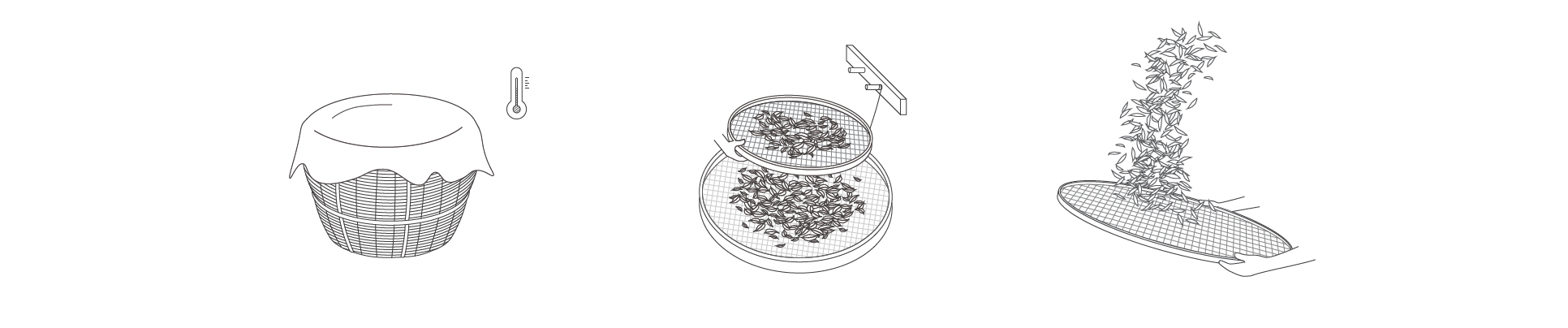
Three-step process: Jar covered with cloth and thermometer, jar with cabbage and weights, cabbage being poured from jar onto a plate.

In fine black tea, the final precision lies in sifting, a step often unseen, yet essential to the tea’s character. Leaves are separated by thickness, length, and weight through a series of practiced hand movements: shaking, circling, lifting, tossing. Each motion has its purpose. Each motion removes light flakes, broken stems, and uneven pieces while preserving the leaf’s natural shape.

The goal is simple but demanding:
even brewing, balanced aroma, and a smooth, consistent taste.

To an untrained eye, it looks effortless.
But in the hands of a skilled tea maker, sifting becomes a rhythm — one learned over years, where every movement shapes the final flavor.

This is why Amber River Black TeaTan (a kind of Tan Yang Gong Fu Black Tea) cannot be rushed or automated.
Its beauty lies in precision, the kind that only hands, experience, and intuition can achieve.